
Reducing Risk & Maintenance Costs with AI-Driven Structural Inspections

Success in civil engineering with AI and computer vision shows the power of digital transformation; yet its potential extends far beyond that sector. Whether in healthcare, finance, manufacturing, or any other industry, let’s drive innovation and efficiency together.

Ready to explore! How can I transform your business?
Connect with me today!
💼 www.linkedin.com/in/abby33459
Introduction:
Structural inspections have long been labor-intensive, relying on manual assessments and time-consuming processes. By integrating AI with high-resolution imaging through industrial camera sensors and Drones (quadcopter), non-destructive testing (NDT), and automated cost estimation, property maintenance is now faster, smarter, and more accurate.
Understanding the Basics of Structural Inspections and Impact of Digital Enablement
Welcome to my exciting journey of transforming property maintenance with AI! Imagine a world where the tedious, manual process of structural inspections evolves into a seamless, AI-driven workflow. Let’s begin by understanding the traditional methods that have laid the foundation for this digital shift.
Traditional Structural Inspection Methods
For decades, ensuring the safety and longevity of buildings, bridges, and other infrastructure relied heavily on manual processes conducted by skilled professionals. The primary techniques are:
Visual Examination Inspectors meticulously assess structural components — beams, columns, walls, slabs, and foundations — looking for visible damage such as cracks, spalling, and corrosion. This forms the cornerstone of any structural assessment.
Non-Destructive Testing (NDT) Techniques like ultrasonic testing, ground-penetrating radar, rebar scanning, eddy current testing, and X-rays evaluate the internal condition of concrete and steel components without damaging the structure.
Destructive Testing For detailed material analysis, core samples or small sections of material are taken for lab testing to determine properties like strength and composition. Civil engineers primarily focus on visual inspection and NDT for quick assessments and risk forecasts in audit reports.
Structural audits require consideration of factors like weather data, geographical location, historical records of natural disasters, and previous maintenance history for accurate evaluations and planning.
Traditional audits demand significant time and effort like below:

Based on 2023 -24 the Indian market price (By Author)
Impact on duration after Deploying the AI solution:
Small Property: 1–2 days
Medium Property: 2–3 days
Large Property: 3–4 days
The Digital Transformation
AI-driven digital solutions revolutionize the Engineering, Procurement, and Construction (EPC) sector:
Time Efficiency: 30%–50% reduction in labor and manual data processing.
Scalability: Enhanced through cloud-based resources, allowing parallel processing of multiple properties
NDT Efficiency: 35% reduction in unnecessary tests, 54% accuracy in selecting NDT methods.
An initial investment of approximately ₹67,00,000 ($80k) is recouped within three months, leading to annual savings of ₹334,000,000 ($4MM). This transformation has spanned multiple countries, including India, New Zealand, and Saudi Arabia.
Environmental and Operational Benefits:
Carbon Emissions: 30% reduction through minimized site visits
Workplace Safety: 20% reduction in accidents with automated inspections
Operational Efficiency: Significant improvements in image analysis time and supply chain management
Operational Efficiency: 99% reduction in image analysis time. (40–50 milliseconds/ image).
Supply Chain Management (SCM):
AI-driven analytics enhance inventory management, reducing stockouts and overstock by 15%, resulting in annual savings of around $500,000.
From high-resolution imaging to NDT, AI makes property maintenance seamless with Drone SOC
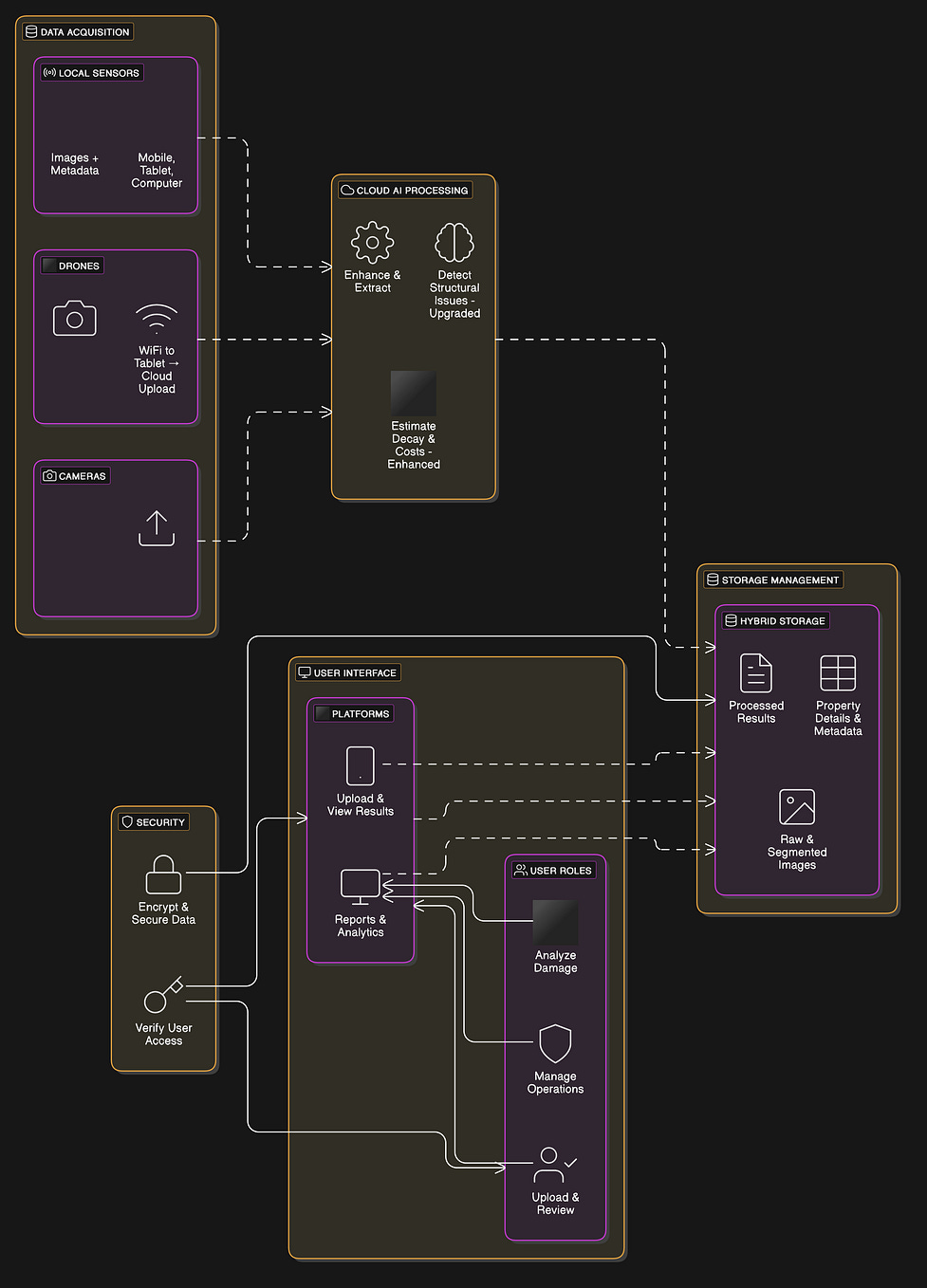
High-Level Architecture of AI-Driven Structural Inspection System (By Autor)
AI technology is transforming traditional property maintenance by automating the categorization of cracks and corrosion, enhancing non-destructive testing (NDT), and ensuring precise maintenance plans.
Categorizing Cracks and Corrosion
We’ve categorized common types of cracks and corrosion into meaningful buckets, simplifying AI detection and severity analysis, and accurate classification for seamless risk analytics of properties, aiding in the understanding of property decay and estimating repair costs.
Note: Categorization considers factors like geographical regions, building materials, and weather conditions.
Enhanced Structural Assessment with NDT
Post-visual inspections, several NDT methods assess the internal conditions of materials like glass, wood, ceramic composites, and polymers. These techniques ensure comprehensive evaluations and effective maintenance plans.
Standards for Capturing Images
High-quality visual inspections follow strict standards:
Equipment: High-resolution cameras, Drones, advanced illuminating devices.
Systematic Coverage and Drone Utilization
Inspections start at the top floor and proceed downwards, covering each room and corridor systematically. The building is divided into sections, each following standard inspection procedures and capturing relevant images and metadata. Safety is paramount, with inspectors using gear for challenging areas. Drones capture high-resolution exterior images, focusing on hard-to-reach spots.
Note: NDT is conducted following a visual inspection of each property.
Infrastructure and Performance Overview
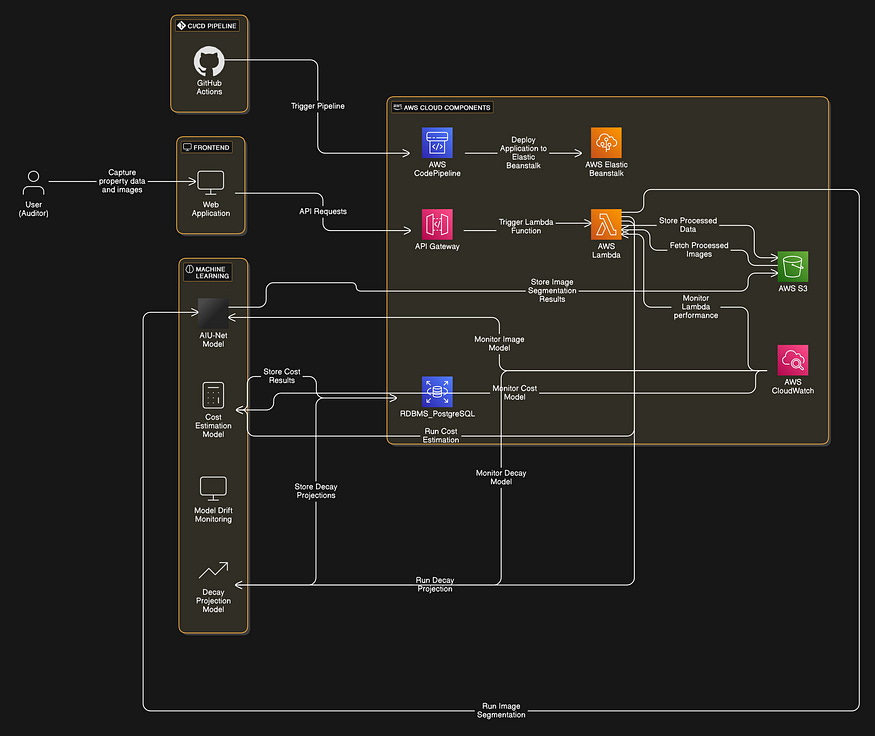
High -level Architecture of Cloud based Components (By Autor)
AI-Powered Property Audits: The Architecture Behind the Transformation
The backbone of our AI-driven structural inspection platform is a serverless web app, designed for auditors, lab analysts, and admins. This cloud-based system not only streamlines property audits but also ensures real-time insights, cost efficiency, and scalability.
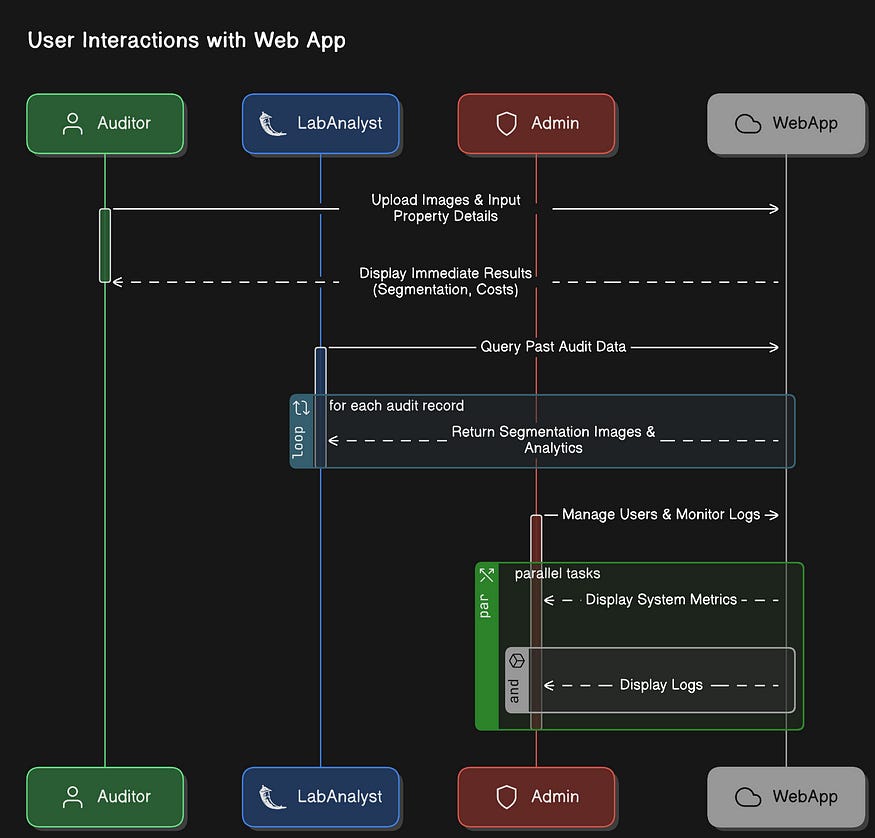
User Interaction of Web App (By Autor)
User Interaction & Automation
Auditors: Upload images via mobile/tablet, and instantly receive segmentation maps, decay severity scores, and cost estimates. They can also access historical audits for comparisons.
Lab Analysts: Review AI-segmented images, refine results, and generate detailed reports with NDT recommendations.
Admins: Oversee user management, monitor system performance, and ensure seamless operations.
By automating image analysis and metadata extraction, the platform drastically reduces manual effort, making audits faster and more accurate.
Infrastructure & Performance
Serverless & Scalable: Built on the Cloud using IOT-based Edge computer with advanced computer vision models.
Storage: Structured, semi-structured, and unstructured image data are efficiently managed within a hybrid storage system.
Processing Power: Handles 150,000 images/month across ~300 properties while maintaining a 45-second response time per audit and 40ms per image processing.
Cost Efficiency: PoC & Production Cost: $4500 → Monthly Ops: $250–$300.
The Impact
By fusing AI with non-destructive testing, we’ve cut costs, improved accuracy, and enabled proactive property maintenance. This shift revolutionizes structural inspections, making them smarter, safer, and future-ready.
Computer Vision Methods and Internal Workflows
Now, let’s have a look at how our AI models are integrated and working internally with a simple flow chart.
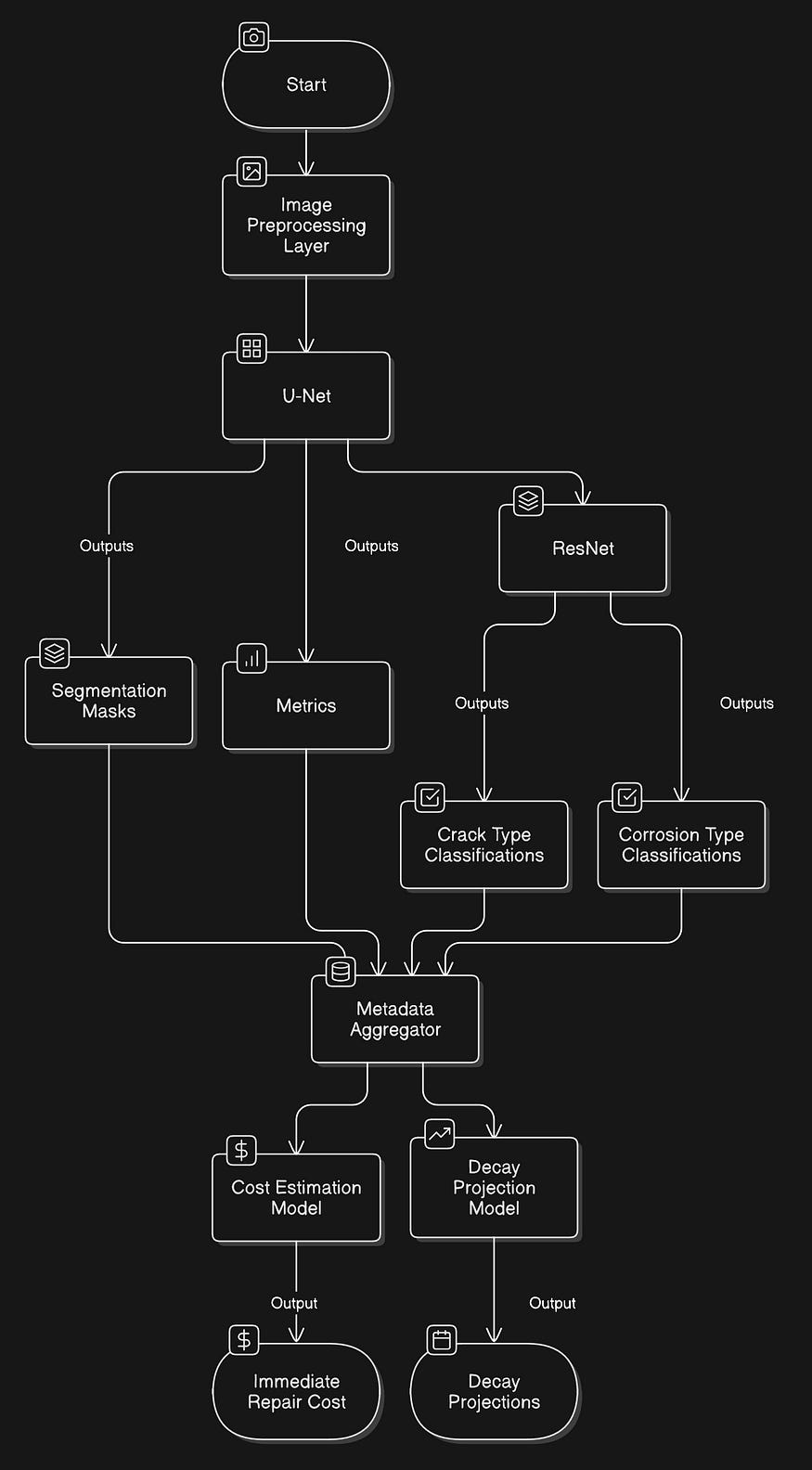
Workflow of AI Solution (By Autor)
Image Preprocessing
Captured images from Cameras manually and drones undergo preprocessing to standardize resolution, remove noise, and enhance quality. Business logic ensures alignment with civil engineering conditions for accurate segmentation.Segmentation & Defect Identification
The AI model processes images to identify and segment structural defects like cracks and corrosion and extract various kinds of features from these images for severity analytics by isolating key attributes necessary for further analysis.Defect Classification
Advanced deep learning techniques ensure precise classification by recognizing complex patterns within structural damage types.Metadata Aggregation
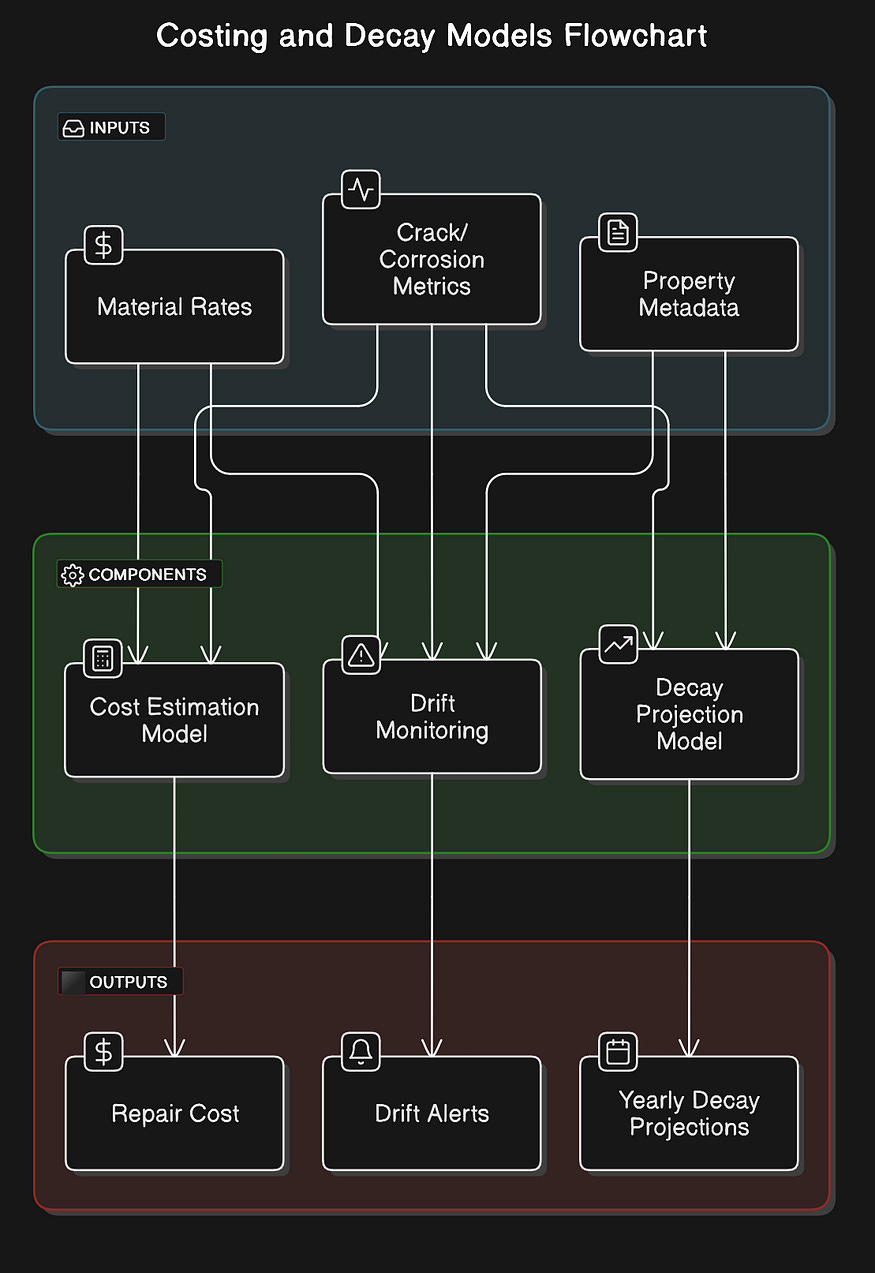
The system consolidates all results produced by computer vision models and the mechanism of the application and processes these for further numerical analysis. A refinement layer enhances accuracy by reducing noise and inconsistencies.Cost Estimation
The AI model predicts repair costs by leveraging historical data, environmental conditions, and structural attributes. This estimation aids in budgeting and planning maintenance strategies faster.Decay Projection
Using proprietary trend analysis, the system forecasts long-term structural degradation, enabling proactive asset management and optimized maintenance schedules.Cloud Setup Training and Development of AI models
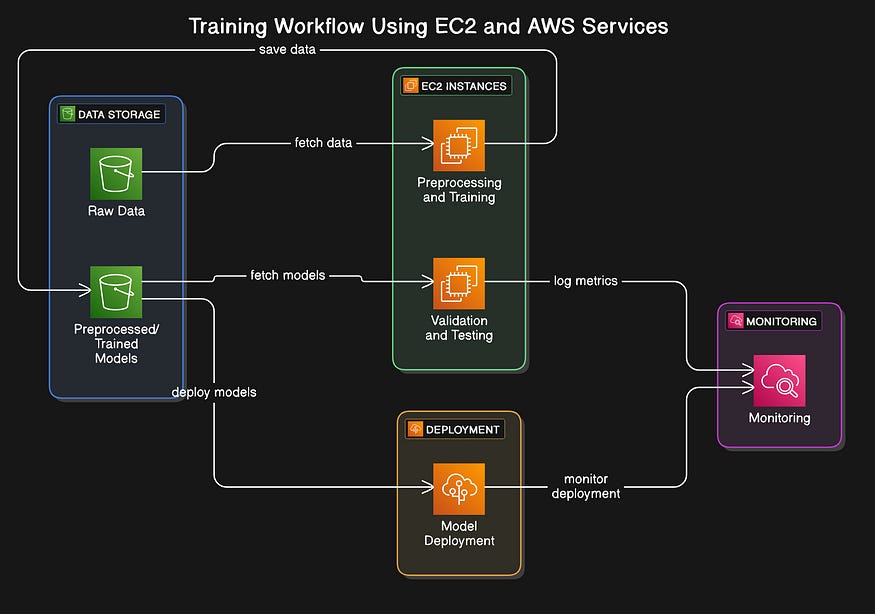
Our pre-production setup ensured smooth AI model training and deployment. High-performance computing resources handled data processing, model training, and validation.
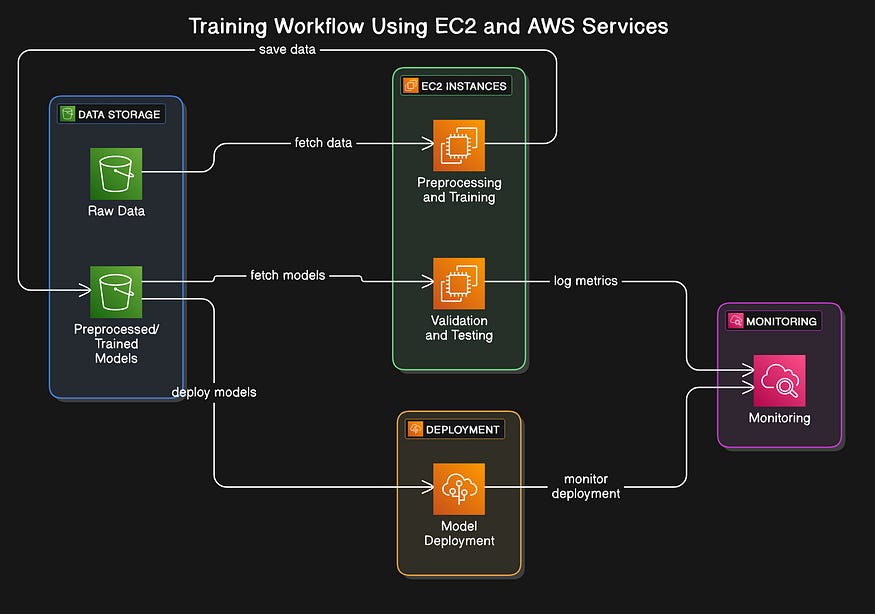
Pre-prod environment for Application development (By Author)
Pre-Production Environment for Application Development
Provisioned Compute Resources — Optimized environment for AI acceleration.
Deployed Web Application — Configured high-performance frameworks for seamless request handling.
Connected to Scalable Storage — Stored preprocessed images securely.
Stored Model Checkpoints & Metadata — Maintained version control for AI models.
Triggered Training Jobs Manually — Launched AI training scripts via remote execution.
Handled API Calls & Security — Implemented secure access and authentication measures.
Monitored Logs & Performance — Used automated monitoring for real-time issue detection and alerts.
Data Pipeline Structure
Data Processing Pipeline — Prepares image data for model training.
Model Training Pipelines — Trains AI and regression models for cost estimation and decay projections.
Prediction Pipeline — Loads trained models, processes images, and stores results securely.
Aggregate Pipeline — Combines outputs for final insights.
Monitoring Pipeline — Tracks model performance for drift detection.
Deployment Pipeline — Automates web app and model deployment.
MLOps and CI/CD Integration
Continuous Integration — Automates code merging and validation.
Continuous Delivery — Prepares models for seamless deployment.
Continuous Deployment — Automates model releases for real-time availability.
By integrating these processes, I ensured efficient AI-driven inspections with minimal downtime during architecting and executing the custom build solution.
Strategic Model Selection and Assessment
Selecting the right models was challenging. During the Proof of Concept (POC), aligning image preprocessing, segmentation, and classification was crucial.
For segmentation, U-Net was chosen over Mask R-CNN and DeepLab. For classification, ResNet-50 was preferred for its balance of accuracy and efficiency.
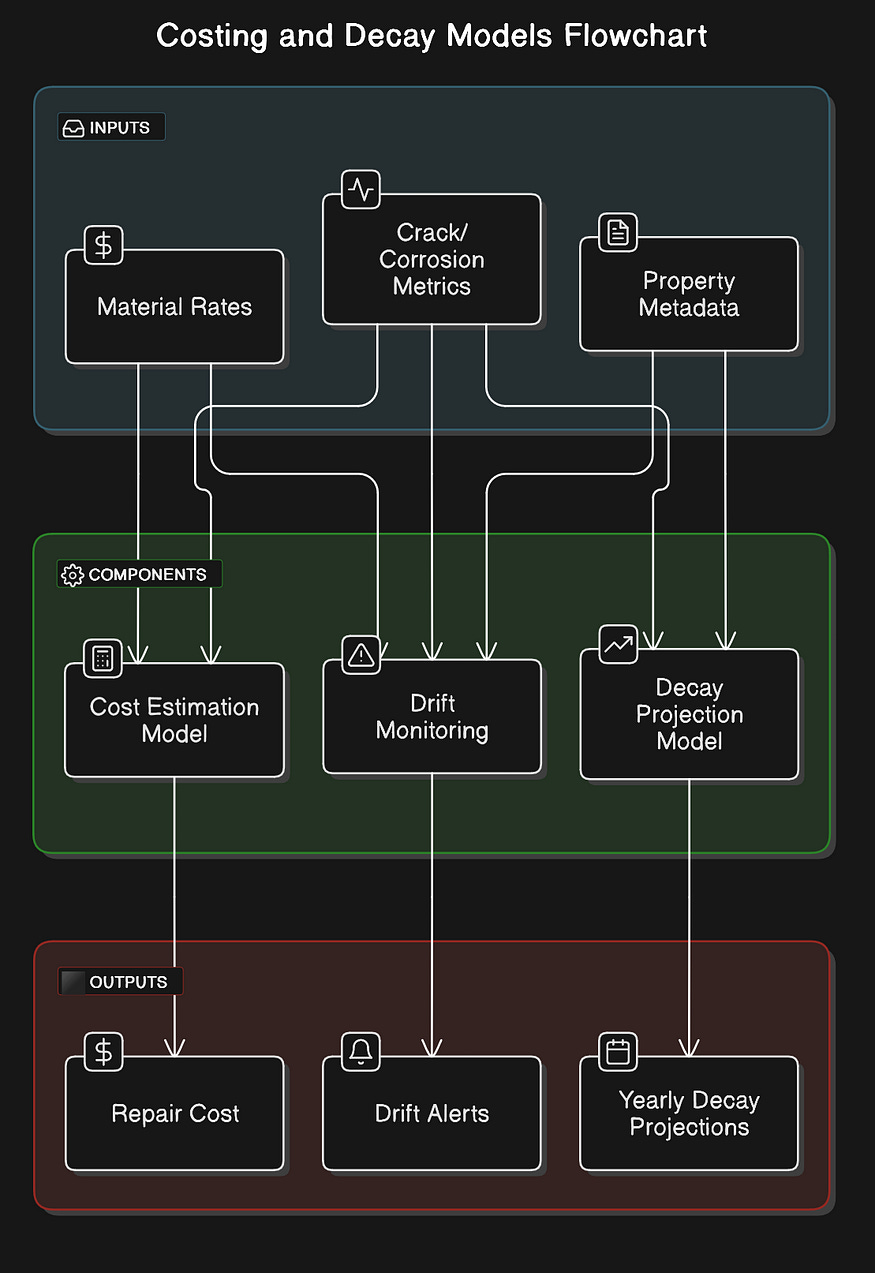
Model Drift and Alert Flow
Key Criteria for Model Selection:
Architecture Fit — Choosing models based on task type (e.g., CNNs for classification, FCNs for segmentation).
Efficiency & Performance — Balancing parameter count, training speed, and accuracy.
Data Suitability — Optimizing for high-resolution images with the right kernel size.
Scalability & Interpretability — Ensuring adaptability to large datasets while maintaining explainability.
Deployment Feasibility — Lightweight models for on-device applications if needed.
Metrics for Model Assessment:
Segmentation — IoU (~0.92 for cracks, ~0.87 for corrosion), Dice coefficient (~0.91).
Classification — Top-1 (~93% for cracks, ~90% for corrosion), F1-score (~91%).
Regression (Decay Projection) — RMSE within 10% deviation, validated by SMEs.
Model Drift & Mitigation:
Drift Detection — Data drift alerts via statistical tests combined with business logic in the monitoring pipeline.
Mitigation — Periodic retraining, augmented datasets, and auditor feedback.
Long-Term Stability — SOP-driven updates ensure adaptation without unnecessary self-training anomalies.
Building a Scalable On-cloud AI Inspection System
A scalable, AI-driven property inspection system ensures seamless processing, strict security, and automated scaling. By integrating cloud automation, we enhance reliability and efficiency, making structural audits smarter and future-proof.
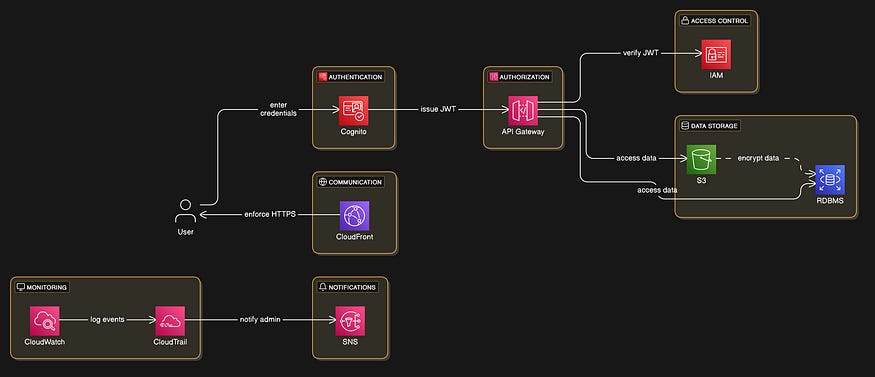
Aws Security & Authentication Architecture (-By Author)
Production-Ready AI Architecture
Seamless Data Flow
Auditor Interaction — Auditors upload images and property details via the web app, by real-time capturing through Drones and Industrial CMOS cameras.
Backend Processing — The API gateway routes data to the Image Processing Layer. The CV(Computer Vision) model detects cracks and corrosion, while the Cost Estimation Model predicts repair costs.
Storage & Predictions — Processed images, metadata, and predictions are stored in cloud-based object storage and RDBMS(Relational Database) with structured indexing.
Results & Monitoring — Automated monitoring ensures prediction reliability, triggering alerts via Function-as-a-Service (FaaS).
Monitoring & Security
A managed monitoring framework tracks user actions, model drift, and system performance.
Secure authentication controls restrict access, while encrypted storage safeguards data.
Automated security monitoring detects and responds to anomalies.
Deployment & Scaling
Hybrid Scaling — FaaS handles variable workloads, while containerized microservices adapt based on demand.
Storage Optimization — Multi-region replication, connection pooling, and indexing enhance efficiency.
Redundancy Management — Balancing performance stability without excessive overhead.
Data Integrity & Compliance, Framework, UAT, Global Applicability
AI-driven property inspections significantly reduce inspection time, enhance defect detection, and ensure compliance, making audits faster, scalable, and cost-effective.
Successful UAT & Market Readiness
1,060 properties tested in 3 months — AI exceeded performance benchmarks.
AI Accuracy: 90%+ defect detection.
Speed: <50ms inference per image, <4 hours per property.
System Uptime: 99%+.
Security: Full compliance with IT & building codes (India, NZ, Saudi Arabia).
Global Compliance & Data Security
Data Encryption: AES-256 (at rest), TLS 1.2+ (in transit).
Access Control: Role-based (Auditors, Admins, Clients).
Incident Response: Instant alerts, 72-hour client notification.
Scalability & Industry Adaptability
Multi-Region Adaptation: Optimized for India, NZ, and Saudi Arabia.
Diverse Damage Detection: AI assesses fire, water, seismic, and industrial damage.
Pre-Demolition Assessments: Prevents structural collapses with AI-driven risk evaluation.
Strategic Impact & Future Vision
This AI solution transforms inspections, reducing compliance risks, cutting costs, and enabling real-time decision-making — a game-changer for smart cities and infrastructure resilience.
If you found the digital transformation of civil engineering intriguing, explore my journey in revolutionizing other sectors with advanced edge computing and embedded AI. Check out the link below!

